
French liaison is one of the features that makes spoken French sound smooth and connected. A consonant that is normally silent at the end of a word can become audible when the next word begins with a vowel sound or a h muet.
But liaison is not automatic. Some liaisons are expected, some are optional, and others should not be made at all.
A French liaison happens when a normally silent final consonant is pronounced before a following vowel sound or h muet.
There are three main categories:
Mandatory: usually expected in close grammatical groups.
Optional: pronunciation varies with style and formality.
Forbidden: the liaison should not be made.
Common liaison sounds include:
S / X → /z/
D → /t/
F → /v/
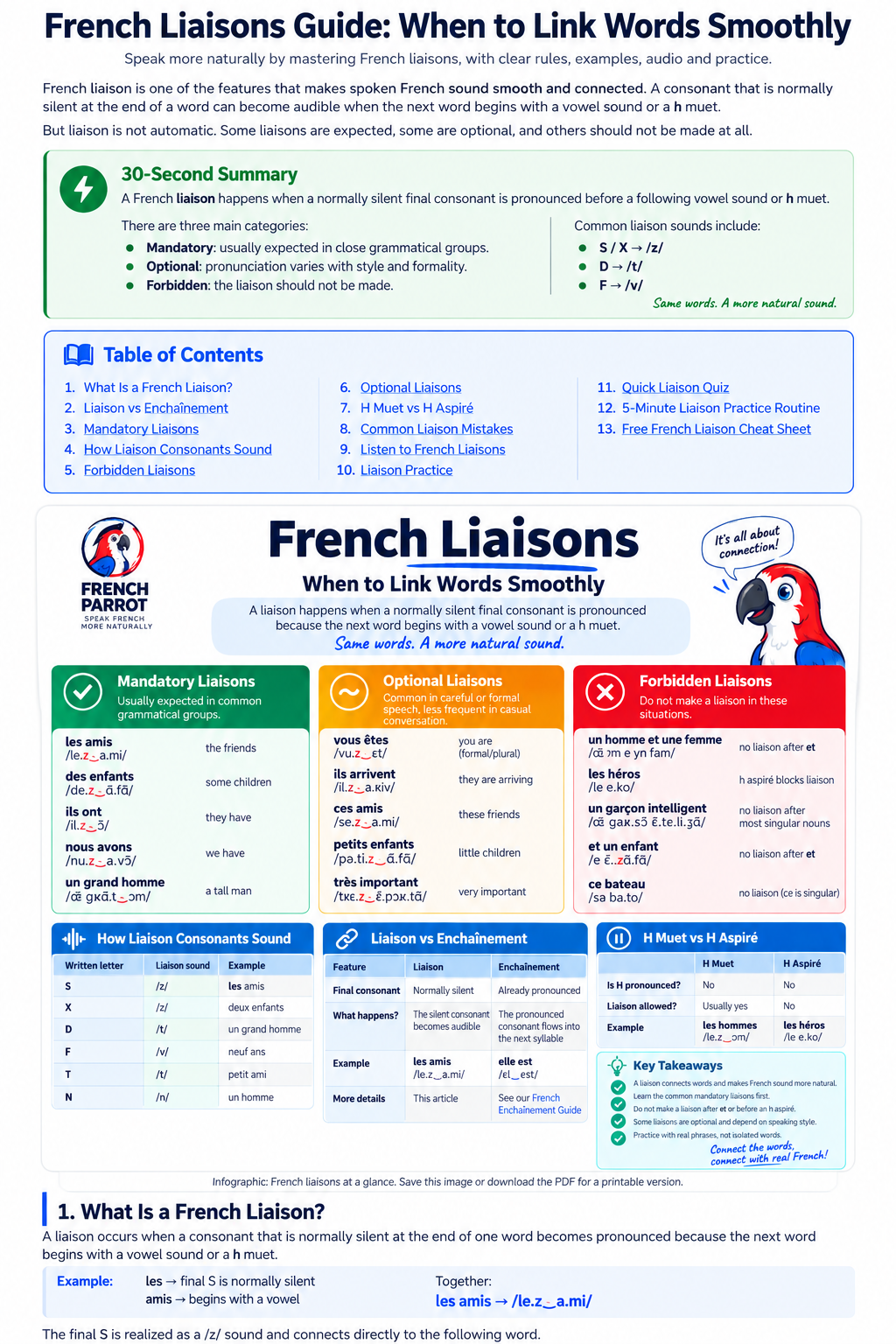
French liaisons at a glance: mandatory, optional and forbidden liaisons, with common pronunciation patterns and examples.
1. What Is a French Liaison?
A liaison occurs when a consonant that is normally silent at the end of one word becomes pronounced because the next word begins with a vowel sound or a h muet.
les → final S is normally silent
amis → begins with a vowel
Together:
les amis → /le.z‿a.mi/
The final S is realized as a /z/ sound and connects directly to the following word.
This phenomenon is part of the wider rhythm of spoken French. If you want the broader overview first, read our guide to French rhythm and liaisons.
2. Liaison vs Enchaînement
Liaison and enchaînement both connect words in spoken French, but they are not the same process.
| Feature | Liaison | Enchaînement |
|---|---|---|
| Final consonant | Normally silent | Already pronounced |
| What happens? | The normally silent consonant becomes audible | The already pronounced consonant flows into the next syllable |
| Example | les amis | elle est |
For a full lesson on the second process, see our French Enchaînement Guide.
3. Mandatory Liaisons
Some liaisons occur in grammatical groups that French speakers normally pronounce as a tightly connected unit.
Determiner + Noun
des enfants → /de.z‿ɑ̃.fɑ̃/
un homme → /œ̃.n‿ɔm/
Subject Pronoun + Verb
nous avons → /nu.z‿a.vɔ̃/
vous êtes → /vu.z‿ɛt/
Some Adjectives Before a Noun
un grand homme → /œ̃ ɡʁɑ̃.t‿ɔm/
Think in grammatical groups rather than isolated words. The closer the words are grammatically, the more likely a liaison is to be expected.
4. How Liaison Consonants Sound
A written final consonant does not always keep its usual spelling-based sound when it appears in a liaison.
| Written Letter | Liaison Sound | Example |
|---|---|---|
| S | /z/ | les amis |
| X | /z/ | deux enfants |
| D | /t/ | un grand homme |
| F | /v/ | neuf ans |
| T | /t/ | petit ami |
| N | /n/ | un homme |
5. Forbidden Liaisons
Some potential liaisons are avoided in standard French.
After “et”
un homme et une femme
There is no liaison between et and une.
Before an H Aspiré
les héros
Although the letter H itself is not pronounced, an h aspiré blocks liaison.
After Many Singular Nouns
un garçon intelligent
The final consonant of the singular noun is not activated simply because the next word begins with a vowel.
Other forbidden contexts exist, so advanced learners should gradually learn them as patterns rather than applying a single universal rule.
6. Optional Liaisons
Some liaisons depend on speaking style.
They are more common in careful or formal speech and may disappear in casual conversation.
More optional liaisons → often sounds more formal or careful.
Fewer optional liaisons → often sounds more conversational.
This is one reason French liaison cannot be learned simply as a list of spelling rules. Register and speaking style also matter.
7. H Muet vs H Aspiré
French has two important types of words beginning with H.
| H Muet | H Aspiré | |
|---|---|---|
| Is H pronounced? | No | No |
| Liaison allowed? | Usually yes | No |
| Example | les hommes | les héros |
8. Common Liaison Mistakes English Speakers Make
Mistake 1: Making Every Possible Liaison
Seeing a vowel at the beginning of the next word does not automatically trigger liaison.
Mistake 2: Avoiding Every Liaison
Skipping mandatory liaisons can make common grammatical groups sound unnatural.
Mistake 3: Pronouncing S as /s/
In common liaison contexts, final S and X are generally realized as /z/.
Mistake 4: Making Liaison After “et”
The conjunction et does not create liaison with the next word.
Mistake 5: Ignoring H Aspiré
Words such as héros block liaison even though the written H is silent.
9. Listen to French Liaisons
Understanding the rules is useful, but your ears also need to recognize how liaisons sound in real speech. Listen once without repeating, then play the audio again and repeat each phrase immediately after the speaker.
🎧 French Liaison Listening & Shadowing Practice
Focus on the connection between words, not on speaking quickly. Listen carefully, pause when necessary, and repeat each phrase aloud.
How to Use the Audio
- Listen once without repeating.
- Listen again and identify the liaison sound.
- Repeat each phrase immediately after the speaker.
- Focus on smooth connection between the words.
- Record yourself if possible and compare your pronunciation.
10. Liaison Practice
Start slowly and connect the words without inserting a pause.
les amis
les enfants
des idées
ils ont
nous avons
vous êtes
un petit ami
un grand homme
Then compare these with phrases where liaison is not allowed:
et une femme
les héros
un garçon intelligent
11. Quick Liaison Quiz
1. How should “les amis” be connected?
A. No consonant between the words
✗ Not quite. The final S becomes /z/ in this liaison.
B. With a /z/ sound
✓ Correct! “Les amis” contains a liaison in /z/.
2. Is there a liaison after “et”?
A. Yes
✗ No. Liaison after “et” is forbidden.
B. No
✓ Correct!
3. What happens before an h aspiré?
A. Liaison is normally blocked
✓ Correct!
B. Liaison is always mandatory
✗ No. An h aspiré blocks liaison.
12. Your 5-Minute Liaison Practice Routine
Minute 1 — /z/ Liaisons
les amis
des enfants
nous avons
Minute 2 — /t/ Liaisons
un grand homme
un petit ami
Minute 3 — Mandatory vs Forbidden
Compare:
les amis ✓
et une amie ✗
les hommes ✓
les héros ✗
Minute 4 — Rhythm
Repeat entire groups without pausing between the linked words.
Minute 5 — Shadowing
Listen to a native model, pause, then imitate the complete phrase rather than the individual words.
13. Download the French Liaison Cheat Sheet
A French Parrot liaison cheat sheet will summarize the mandatory, optional, and forbidden patterns, common consonant changes, and useful practice phrases.
Final Takeaway
French liaison is not simply “pronounce the final consonant before every vowel.”
The real system is:
mandatory → optional → forbidden
Start by mastering the high-frequency mandatory liaisons, learn the most important forbidden contexts, and only then worry about optional liaisons and stylistic variation.
The goal is not to add as many liaisons as possible. The goal is to connect words in the places where French naturally expects them.