
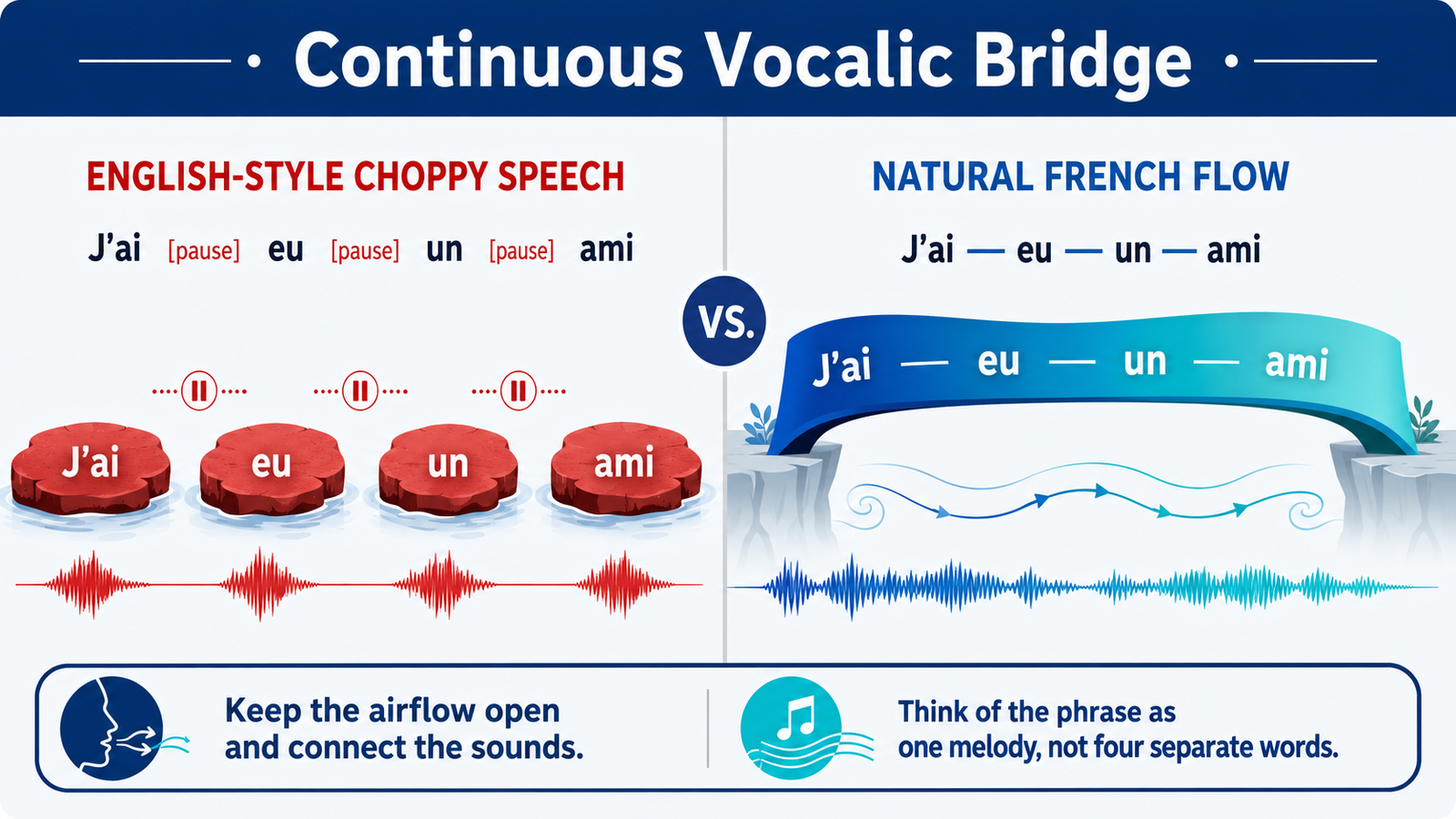
Have you ever listened to French speakers and felt like an entire sentence was just one giant, unbroken word? That seamless, liquid flow is driven by a linguistic concept called enchaînement vocalique (vowel linking).
Unlike English, where speakers regularly drop glottal stops between words ending and starting with vowels (like saying “I… ate… an… apple”), French pushes air continuously across word boundaries. This technique is a crucial extension of mastering standard French speech rhythm, elevating your oral fluency dramatically.
1. What Makes Enchaînement Different from Liaisons?
It is easy to confuse liaisons and enchaînement, but they involve distinct mechanics:
- Liaison: A normally silent final consonant becomes active to connect to a vowel (e.g., les_amis).
- Enchaînement Vocalique: A final vowel transitions directly into an initial vowel without any consonant bridge or breath pause (e.g., J’ai eu → “Jé-ew”).
When executing this technique, make sure your tongue transitions quickly between mouth positions, similar to how you adjust your mouth when learning to distinguish the French ‘U’ and ‘OU’ sounds.
2. How to Practice Vowel Linking
To train your throat and vocal cords not to cut off air between words, use the “Single-Breath Slur” method:
- Inhale deeply through your nose.
- Begin vocalizing the first word’s vowel sound.
- Glide your tongue and lips smoothly into the next vowel shape without stopping your breath or closing your throat vocal cords.
You can listen to audio examples of connected continuous speech on the Phonétique FLE portal to train your ear to recognize unbroken vowel chains.
Vowel Linking Self-Check
What happens to your breath flow during enchaînement vocalique?
3. Common Everyday Phrases with Vowel Linking
Practice glided vowel connections using these frequent combinations:
- Tu as eu… (“Too-ah-ew…”)
- J’ai appris… (“Jé-ah-pree…”)
- Il a essayé… (“Eel-ah-eh-say-yé…”)
Download the summary PDF guide for this lesson to practice offline.