
FRENCH PARROT · PRONUNCIATION LAB · A2–B1
French E Muet: When to Pronounce or Drop the E
Learn to hear the weak French vowel, understand when it disappears, and practice natural pronunciation without guessing.

Why does samedi sometimes sound like sam’di? Why do you hear a vowel in je te parle in careful speech but fewer vowels in relaxed conversation? The answer often involves the e muet (also called e caduc or, in many descriptions, schwa).
1. What exactly is the French e muet?
The term e muet literally means “mute e,” but it is a little misleading: the relevant vowel may be pronounced or omitted. In common descriptions of metropolitan French, the variable vowel is represented as /ə/. When pronounced, its exact quality can vary by speaker and accent and may resemble a rounded central or front vowel.
Compare the careful and reduced versions of samedi (“Saturday”):
| Version | Approximate pronunciation | Syllables |
|---|---|---|
| Careful: samedi | /samədi/ | 3 |
| Often reduced: sam’di | /samdi/ | 2 |
The apostrophe in sam’di is only an informal pronunciation aid. In normal French writing, always spell the word samedi.
2. Three places where you will encounter it
A. Inside certain words
In samedi and petit, the weak vowel may be omitted in everyday pronunciation: samedi → sam’di; petit → p’tit. The reduced version is not mandatory for every speaker or every situation.
B. In short grammatical words
Words such as je, me, te, se, le can contain a weak vowel. In connected speech, that vowel may disappear in some contexts. For example, je te demande may be pronounced with fewer syllables than in a careful reading. The exact reduction varies; it is not a fixed replacement spelling.
C. At the ends of written words
In much of contemporary northern metropolitan French, a final unaccented written -e is normally silent: table is commonly /tabl/, not */tablə/ in ordinary isolated pronunciation. However, in some southern varieties of French, in poetry, or in singing, an additional vowel may be heard. That is a different environment from the variable internal vowel in samedi.
3. When can the e muet disappear?
There is no single mechanical rule that works for every word and accent. These tendencies are especially useful for learners:
| Context | What often happens | Example |
|---|---|---|
| Between consonants in familiar words | Schwa may drop | samedi → sam’di |
| In short unstressed words | Schwa may drop in connected speech | je te parle |
| When deletion creates a hard consonant sequence | Schwa is more likely to be kept | compare careful and rapid speech |
| Careful speech or emphasis | Schwa is often more audible | slow, clear repetition |
| Regional varieties | Retention patterns differ | southern vs northern varieties |
A traditional classroom guideline sometimes called the “three-consonant rule” predicts that schwa tends to be retained when deleting it would produce a difficult cluster of three consonants. It is a tendency, not an exception-free law: syllable structure, consonant identity, accent and speaking style all matter.
4. Five common mistakes English speakers make
- Pronouncing every written e. French spelling and sound do not match one-to-one.
- Deleting every weak vowel. Some deletions make consonant groups awkward or unnatural.
- Confusing é with e muet. Été does not become ’té by the same rule.
- Thinking all French speakers sound identical. Schwa use differs by region and situation.
- Practicing only individual words. The rhythm of the whole phrase influences what you hear.
5. Listen and repeat: a guided practice
🎧 Listen & Repeat — French E Muet Pronunciation Practice
Improve your French pronunciation with this guided listening and repetition exercise from French Parrot.
Discover how the French e muet changes in everyday speech. Listen to careful and natural pronunciations, then repeat during the pauses.
How to practise:
- Listen carefully to each French example.
- Repeat aloud during the pauses.
- Compare careful and natural pronunciation.
- Play the recording again to improve your rhythm and fluency.
Ready? Press play and practise with French Parrot!
6. Test your understanding
7. Your 5-minute shadowing routine
- Minute 1: Say samedi slowly, then listen for a two-syllable version.
- Minute 2: Compare careful and relaxed versions of petit.
- Minute 3: Repeat je te demande as one rhythmic group.
- Minute 4: Listen to short natural French recordings and mark weak vowels you do or do not hear.
- Minute 5: Record yourself and compare with a native-speaker model. Prioritize clarity, not maximum speed.
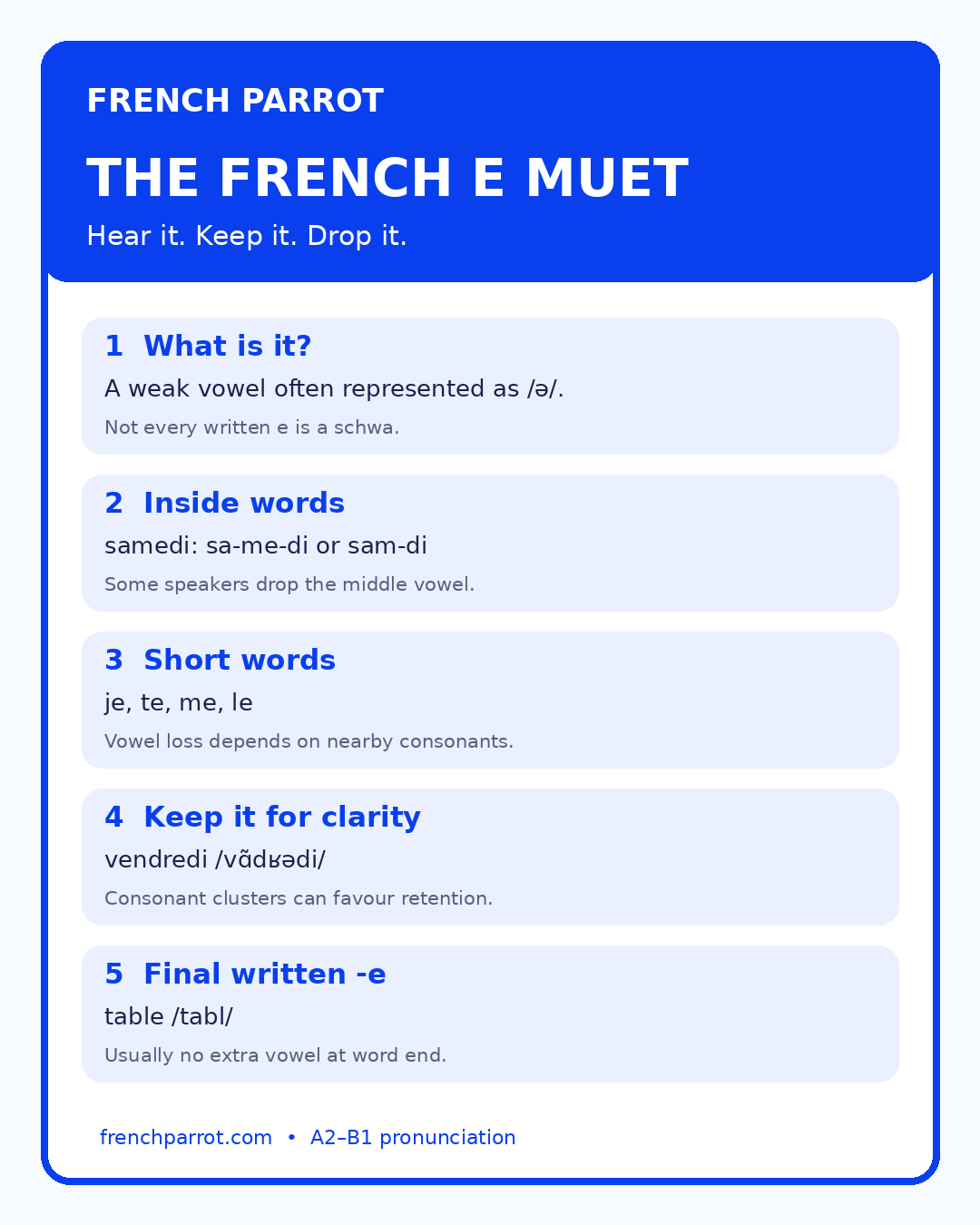
8. Free visual guide and printable worksheet
9. Frequently asked questions
Is the French e muet always silent?
No. In many contexts it can be pronounced or omitted, depending on the word, surrounding sounds, accent and speaking style.
Is e muet the same as schwa?
They are often used together in learner materials, but the traditional French term covers spelling and pronunciation patterns that require context. Not every written e represents /ə/.
Should I drop the e when I speak French?
First learn to recognize variation. Use clear pronunciation; reductions can develop naturally as your listening and rhythm improve.
Why does my French teacher pronounce a vowel that I do not hear in films?
Careful classroom speech often retains vowels that may be omitted in relaxed conversation. Regional variation can also contribute.
10. Keep learning with French Parrot
Now that you can identify the variable e, discover how it interacts with other spoken reductions in our guide to everyday French reductions. For one familiar phrase, read why “je ne sais pas” can sound like “j’sais pas”.