
If the French words tu and tout sound almost identical to you, you are not alone. The French U and OU sounds are one of the most common pronunciation challenges for English speakers.
The good news is that the difference is systematic. Once you understand what your lips and tongue are doing, you can learn to hear the contrast and produce both sounds much more reliably.
French U is pronounced /y/.
French OU is pronounced /u/.
The lips are rounded for both sounds. The major difference is the position of the tongue:
U: tongue forward.
OU: tongue farther back.
1. What Is the Difference Between French U and OU?
French spelling makes these two sounds look similar, but phonetically they are very different.
| Spelling | IPA | Example | Tongue position |
|---|---|---|---|
| U | /y/ | tu | Forward |
| OU | /u/ | tout | Back |
The OU sound is relatively familiar to English speakers because it is close to the vowel in English words such as food or moon.
The French U sound is different. Standard English does not normally use the same vowel, so English speakers often replace it with OU.
tu ≠ tout
rue ≠ roue
vu ≠ vous
2. How to Pronounce French U /y/
To pronounce French U, you need to combine two movements that may initially feel unusual.
Step 1: Say “EE”
Start by producing the vowel sound in the English word see.
Notice where your tongue is:
- high in the mouth,
- toward the front,
- close to the position used for French i.
Step 2: Keep Your Tongue There
This is the most important part. Do not allow your tongue to move backward.
Step 3: Round Your Lips
While keeping the tongue in the same forward position, round your lips as if you were going to whistle.
EE → round the lips → U /y/
Think of French U as an “EE” sound produced with rounded lips.
3. How to Pronounce French OU /u/
French OU is usually easier for English speakers.
Round your lips and move the tongue farther toward the back of the mouth.
The result is similar to the vowel sound in:
- food
- moon
- school
French OU is generally produced more cleanly and steadily than many English vowels, so avoid turning it into a diphthong.
U /y/ → lips rounded + tongue forward
OU /u/ → lips rounded + tongue farther back
4. The EE → U Technique
This is one of the easiest ways to teach your mouth the French U sound.
- Say EEEEE.
- Keep your tongue completely still.
- Slowly round your lips.
- Do not let the tongue move backward.
- The sound should gradually become French U /y/.
Practice the movement several times even without using a French word:
EE → U
EE → U
EE → U
Once the movement feels comfortable, try:
tu — vu — rue — jus
5. Listen to the French U vs OU Difference
Reading about pronunciation is useful, but your ears also need training. Listen to the audio below and focus specifically on the contrast between the two vowels.
🎧 French U vs OU Listening Practice
Listen carefully, pause when necessary, and repeat each sound aloud.
How to Use the Audio
- Listen once without repeating.
- Listen again and identify U or OU.
- Repeat each example immediately after the speaker.
- Record yourself if possible.
- Compare your pronunciation with the original audio.
6. Minimal Pairs to Practice
Minimal pairs are words that differ mainly by one sound. They are extremely useful for training your ears and mouth.
| French U /y/ | French OU /u/ |
|---|---|
| tu | tout |
| vu | vous |
| rue | roue |
| jus | joue |
| lu | loup |
tu — tout — tu — tout
vu — vous — vu — vous
rue — roue — rue — roue
jus — joue — jus — joue
lu — loup — lu — loup
Do not focus on speed at first. Exaggerate the tongue position so that your brain learns the physical difference.
7. French Pronunciation: A Visual Guide
Pronunciation becomes much easier when you can visualize what the mouth is doing. Use the infographic below as a quick reference while practicing.
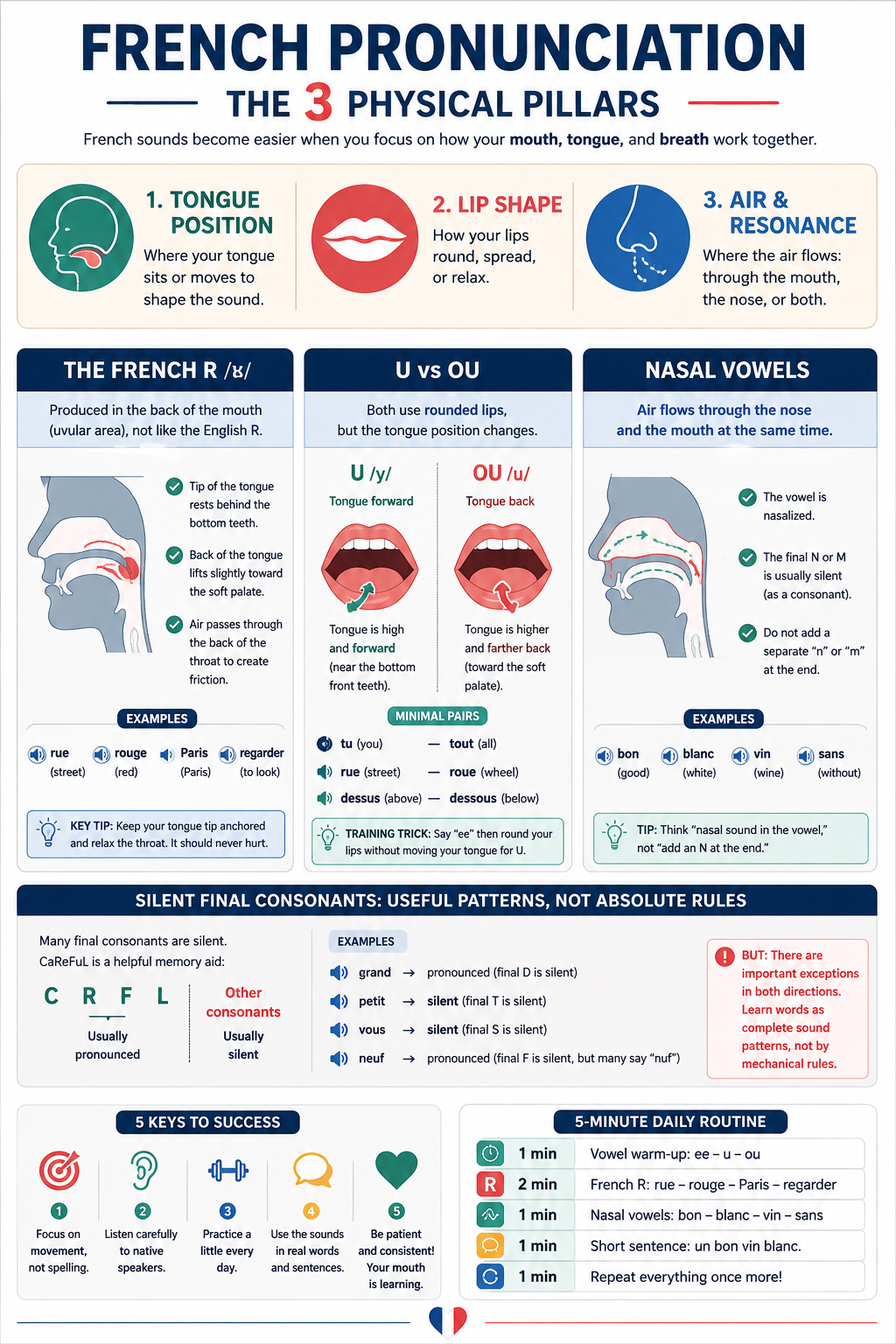
French pronunciation visual guide — French Parrot
8. Common Mistakes English Speakers Make
Mistake 1: Pronouncing U Like OU
This is the most common mistake.
If tu sounds like tout, your tongue is probably moving too far backward.
Mistake 2: Moving the Jaw Too Much
You do not need a large jaw movement to distinguish these sounds. The important movement happens mainly with the tongue and lips.
Mistake 3: Trying to Learn the Sound Only by Listening
Listening is essential, but pronunciation is also physical. You need to teach your muscles where to go.
That is why the EE → U technique is so effective.
Mistake 4: Practicing Whole Sentences Too Soon
If you cannot reliably produce the vowel by itself, long sentences make the task much harder.
Use this progression:
9. A 5-Minute U vs OU Pronunciation Routine
You do not need a long pronunciation session. Five focused minutes every day can be more effective than one long session once a week.
Minute 1 — Mouth Position
Repeat:
EE → U
EE → U
EE → U
Minute 2 — Isolated Sounds
U — OU — U — OU
Minute 3 — Minimal Pairs
tu / tout
vu / vous
rue / roue
jus / joue
Minute 4 — Listen and Repeat
Use the audio in this article and imitate the pronunciation as closely as possible.
Minute 5 — Record Yourself
Say three or four pairs into your phone and listen back. Can you clearly hear two different vowels?
10. Quick French U vs OU Quiz
Test whether you understand how the two sounds work.
11. Download the Free French U vs OU Cheat Sheet
Want a quick reference you can keep next to you while practicing? Download the French Parrot U vs OU Pronunciation Cheat Sheet.
It summarizes the tongue and lip positions, the EE → U technique, useful word pairs, and a short pronunciation routine.
Final Takeaway
The difference between French U and OU is not simply about rounding your lips.
Your lips are rounded for both sounds.
The key is your tongue position.
U /y/: tongue forward.
OU /u/: tongue farther back.
When in doubt, return to the simplest technique:
EE → keep the tongue forward → round the lips → U
Practice a few minutes every day, listen carefully, and exaggerate the contrast at first. With repetition, your ears and mouth will gradually learn to treat U and OU as two completely different French sounds.