
You can pronounce individual French sounds correctly and still sound unnatural. Why? Because natural French depends not only on sounds, but also on rhythm, grouping, stress and connection between words.
English speakers often bring English stress patterns into French. They may strongly emphasize individual words, reduce other syllables or insert small pauses between words. French speech usually organizes information differently: words are grouped into smooth rhythmic units, with the main accent typically heard near the end of each group.
Natural French rhythm is built around rhythmic groups rather than strongly stressed individual words.
To sound smoother in French:
1. Avoid giving every important word a strong English-style stress.
2. Speak in short rhythmic groups.
3. Let the strongest accent fall naturally near the end of the group.
4. Connect words through liaison and enchaînement when French pronunciation requires it.
5. Practice complete phrases instead of isolated words.
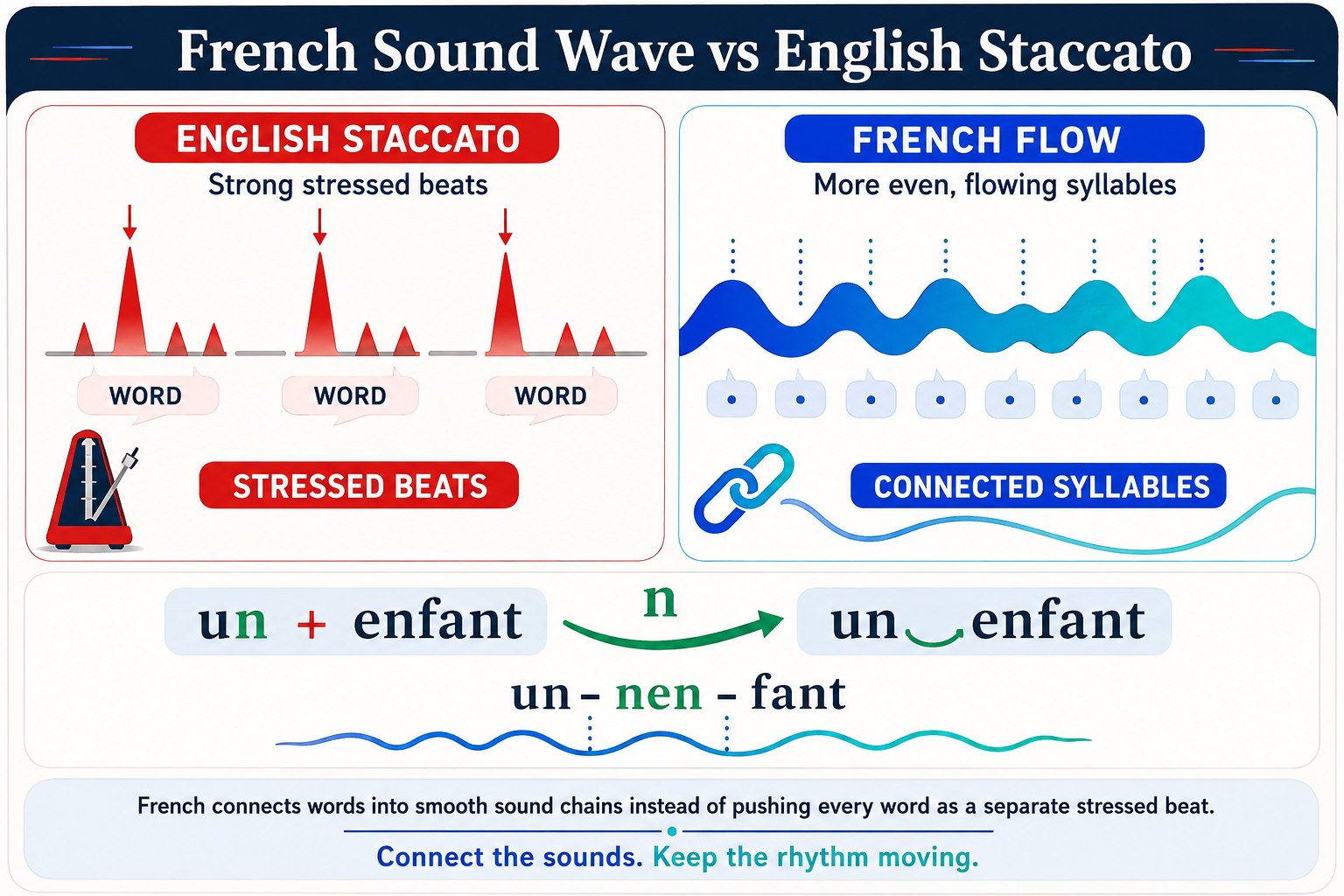
English often relies on stronger word stress, while French speech tends to flow through connected rhythmic groups.
1. How French Rhythm Differs from English
English and French organize spoken rhythm differently.
English often gives strong prominence to important words while reducing or compressing less important syllables. French generally relies less on strong stress contrasts inside individual words and organizes speech into larger rhythmic groups.
| English | French |
|---|---|
| Strong stress contrasts between syllables | More even syllable flow within a rhythmic group |
| Important words may receive strong emphasis | The main accent usually appears near the end of a group |
| Unstressed syllables may be heavily reduced | Syllables often remain more clearly articulated |
| Speakers may emphasize several separate words | Words often combine into one rhythmic unit |
Do not interpret this as “every French syllable has exactly the same length.” Real speech naturally varies. For learners, the useful goal is simply to avoid importing exaggerated English-style stress into every French word.
2. Speak in Rhythmic Groups
One of the most useful ways to improve your French rhythm is to stop thinking word by word.
Instead, organize a sentence into short rhythmic groups. Each group carries one idea and is pronounced as a connected unit.
Instead of thinking:
Je / vais / au / cinéma / ce / soir.
Think:Je vais au cinéma / ce soir.
The exact grouping can vary depending on meaning, speed and speaking style. The important point is that French speech does not normally sound like a sequence of isolated dictionary words.
When reading aloud, draw a small slash between meaningful groups. Then speak each group in one smooth movement.
3. French Stress: Listen to the End of the Group
English speakers often search for the “stressed syllable” of every French word.
That approach can be misleading because French stress works differently from English lexical stress.
In neutral French speech, the most noticeable accent usually appears near the end of a rhythmic group, rather than being permanently attached to one syllable of every word.
Je vais au restauRANT.
Il arrive deMAIN.
On se retrouve à huit HEURES.
The capital letters above are only a learner-friendly visual cue. You do not need to shout or heavily stress these syllables. The accent is generally much lighter than typical English stress.
Do not punch the final syllable aggressively. French final-group accent is not the same as strongly stressing an English word.
4. Liaison: Activating a Silent Consonant
Liaison is one of the mechanisms that helps French words connect.
A liaison occurs when a final consonant that is normally silent becomes audible before a following vowel sound or h muet.
nous avons → the final S becomes /z/
un petit ami → the final T is pronounced
But liaison is not automatic. Some liaisons are mandatory, others optional and others forbidden.
For the complete rules and practice examples, read our French Liaison Guide: When to Link Words Smoothly.
Liaison is only one part of French rhythm. Do not try to create a liaison every time the next word begins with a vowel.
5. Enchaînement: Carrying a Consonant Forward
Liaison and enchaînement both connect words, but they are not the same phenomenon.
With enchaînement consonantique, the final consonant is already pronounced when the word appears alone. In connected speech, that consonant flows naturally into the syllable beginning with the next vowel.
elle est
The final L of elle is already pronounced. When the phrase is spoken smoothly, the consonant connects naturally with the following vowel.| Liaison | Enchaînement | |
|---|---|---|
| Final consonant | Normally silent | Already pronounced |
| What happens? | The consonant becomes audible | The consonant carries into the next syllable |
| Example | les amis | elle est |
For a complete explanation and additional examples, see our French Enchaînement Guide.
6. Build Smooth French Flow
Natural rhythm does not mean speaking fast.
A learner who speaks slowly but connects words correctly can sound much more natural than someone who speaks quickly with English-style stress and pauses between every word.
Practice Meaning Groups
Je voudrais un café / s’il vous plaît.
Nous allons au cinéma / ce soir.
Il arrive à Paris / demain matin.
Keep the Airflow Moving
Try not to stop your voice between every word. Within a rhythmic group, allow the sounds to connect naturally.
Slow Down Before Speeding Up
Practice the rhythm slowly first. Once the phrase feels smooth, gradually increase your speed without changing the connections.
7. Listen and Shadow French Rhythm
Rhythm is difficult to learn from written explanations alone. Your ears need repeated exposure to connected French speech.
🎧 French Rhythm & Liaisons Listening Practice
Listen once without repeating. Then play the recording again and imitate the rhythm, connections and final-group accent.
How to Practice with the Audio
- Listen once without speaking.
- Listen again and identify where words connect.
- Repeat complete phrases rather than individual words.
- Copy the speaker’s rhythm before worrying about speed.
- Record yourself and compare your version with the model.
8. Common Rhythm Mistakes English Speakers Make
Mistake 1: Stressing Every Important Word
English-style emphasis can make French sound fragmented. Try to think in rhythmic groups instead.
Mistake 2: Speaking Word by Word
Pausing between every word prevents the natural connections that French speech relies on.
Mistake 3: Trying to Speak Fast
Speed does not create fluency. Smooth grouping and connection are more important.
Mistake 4: Making Every Possible Liaison
Liaison follows grammatical and pronunciation rules. A vowel at the beginning of the next word does not automatically mean you should pronounce the previous final consonant.
Mistake 5: Confusing Liaison with Enchaînement
In liaison, a normally silent consonant becomes audible. In enchaînement, the consonant is already pronounced.
Mistake 6: Over-Stressing the End of Every Word
French final accent belongs primarily to the rhythmic group, not to every isolated word.
9. Quick French Rhythm Quiz
1. Where is the most noticeable neutral French accent usually heard?
A. On the first syllable of every word
✗ Not quite. French does not normally place strong lexical stress on the first syllable of each word.
B. Near the end of a rhythmic group
✓ Correct! French rhythm often places the main accent near the end of a meaningful group.
2. What is the main difference between liaison and enchaînement?
A. In liaison, the consonant is normally silent
✓ Correct! A normally silent consonant becomes audible in liaison.
B. They are exactly the same phenomenon
✗ No. In enchaînement, the final consonant is already pronounced.
3. What should you focus on before trying to speak faster?
A. Smooth rhythmic groups and connections
✓ Correct! Build the rhythm first. Speed can come later.
B. Pronouncing every word separately
✗ No. Word-by-word pronunciation usually makes French sound less natural.
10. Your 5-Minute French Rhythm Practice Routine
Minute 1 — Find the Groups
Take one short sentence and divide it into meaningful rhythmic groups.
Je vais au cinéma / ce soir.
Minute 2 — Final-Group Accent
Repeat each group and allow a light natural accent near the end.
Minute 3 — Word Connections
Practice:
les amis
nous avons
elle est
avec elle
Minute 4 — Read Smoothly
Read one sentence without stopping between every word. Pause only at natural group boundaries.
Minute 5 — Shadowing
Play a short native recording and repeat immediately after the speaker. Copy the rhythm, pauses and connections instead of focusing only on individual sounds.
11. Download the French Rhythm Cheat Sheet
Keep the key ideas from this lesson with you while practicing. The one-page French Parrot rhythm cheat sheet summarizes rhythmic groups, final-group accent, liaison, enchaînement and a quick daily practice routine.
📄 French Rhythm & Liaisons Cheat Sheet
Use this printable guide as a quick reference during your pronunciation practice.
Download the Free Rhythm Cheat SheetFinal Takeaway
Natural French is not created by pronouncing every word perfectly in isolation.
It comes from learning how words behave together.
rhythmic groups → light final accent → connected speech
Start by grouping your sentences naturally. Then work on liaison, enchaînement and shadowing.
Do not chase speed. Build smooth rhythm first, and faster speech will become much easier later.