
French pronunciation can feel surprisingly physical to English speakers. You may know exactly what you want to say, yet your lips and tongue seem unwilling to cooperate. The problem is often not vocabulary or grammar. It is learning a new set of articulatory habits.
The good news is that you do not need a “perfect French accent” to communicate clearly. By understanding where your tongue sits, how your lips move, and how air resonates through the mouth and nose, you can make difficult French sounds easier to produce and easier to recognize when native speakers use them.
⚡ 30-Second Summary
French pronunciation becomes easier when you stop treating it as spelling and start treating it as movement.
- The French R is usually produced toward the back of the mouth, not with the English R tongue shape.
- French U and OU differ mainly in tongue position while both use rounded lips.
- French nasal vowels combine oral and nasal resonance rather than pronouncing a full final N or M.
- Many final consonants are silent, but pronunciation depends on the word and context—not on one universal rule.
- Short, regular practice is more useful than forcing difficult sounds for long periods.
In This Guide
1. The Physical Mechanics of French Pronunciation
English and French use the same speech organs, but they organize some sounds differently. A familiar letter can therefore tempt an English speaker into using an English articulation even when French requires another tongue or lip position.
Instead of asking only, “What letter am I reading?”, start asking three physical questions:
- Tongue: Is it forward, central, or raised toward the back of the mouth?
- Lips: Are they relaxed, spread, or rounded?
- Air and resonance: Is the sound primarily oral, or does nasal resonance also play a role?
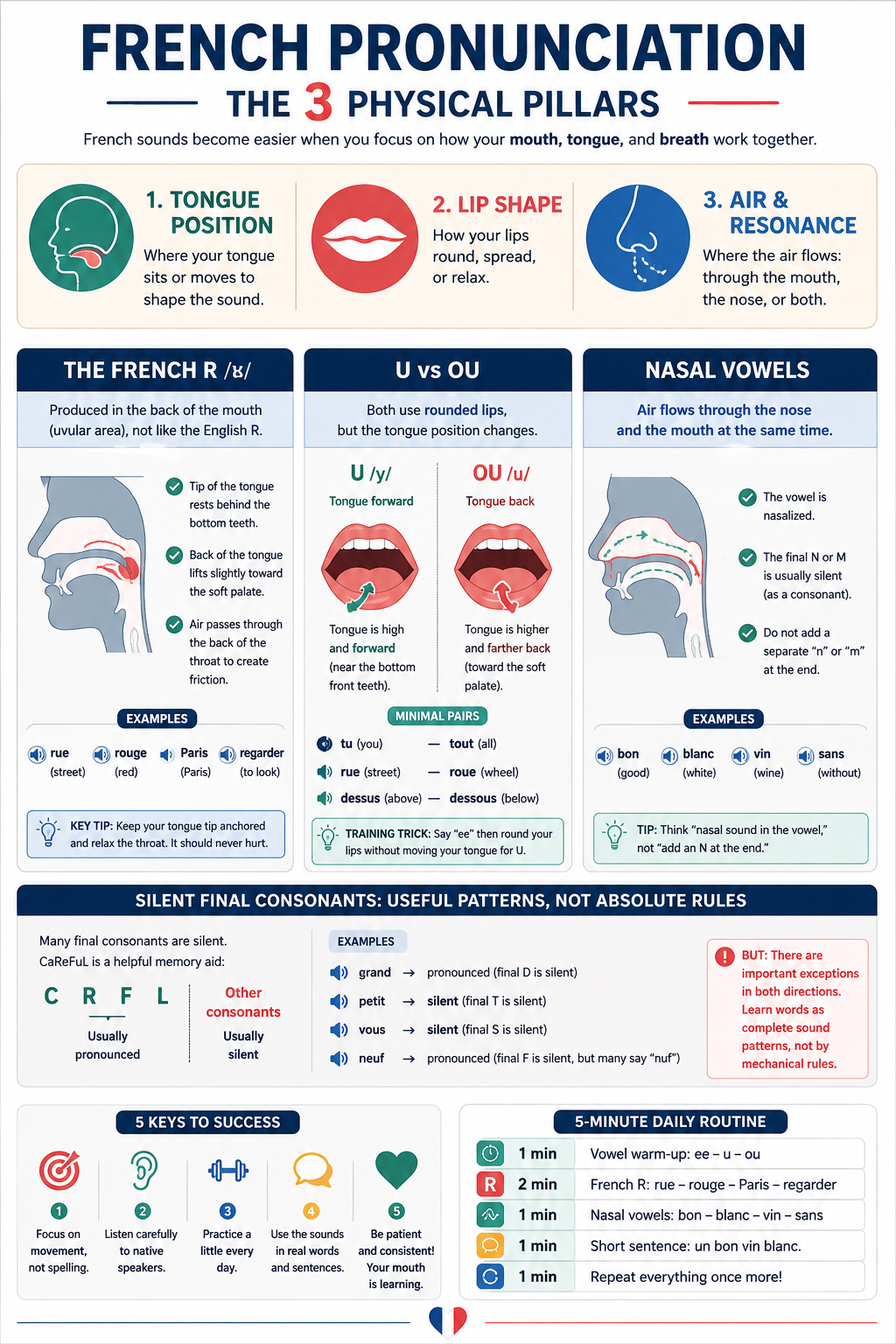
French Pronunciation: A Visual Guide — tongue position, lip shape, airflow and the hardest sounds for English speakers.
2. The French R: Use the Back of the Mouth, Not the English R
One of the most recognizable sounds in French is the letter R. In many varieties of contemporary French, it is produced in the uvular region, toward the back of the mouth. This is very different from the typical English R.
A useful beginner strategy is to keep the tip of the tongue relaxed and low while learning to control the back of the tongue. You should not need to scrape, squeeze, or painfully force the throat.
Because this sound deserves more than a short explanation, French Parrot has a dedicated lesson with a step-by-step technique:
→ Learn how to pronounce the French R without throat pain
Practice slowly with words such as rue, rien, rouge, and Paris. Your goal at first is not speed. It is a repeatable, comfortable articulation.
3. French U vs OU: One Lip Shape, Two Tongue Positions
The distinction between French U and OU is especially important because changing the vowel can change the word itself.
| Sound | Example | IPA | Main Physical Cue |
|---|---|---|---|
| U | tu, rue, vu | /y/ | Tongue forward + lips rounded |
| OU | tout, roue, vous | /u/ | Tongue farther back + lips rounded |
The “EE → U” Training Trick
- Say a long English “ee” sound, as in see.
- Keep approximately that forward tongue position.
- Without pulling the tongue backward, round your lips.
- Repeat slowly until you can maintain the forward tongue position while rounding the lips.
French Parrot’s dedicated U vs OU pronunciation lesson will expand this contrast with minimal pairs and focused practice.
4. Nasal Vowels: Don’t Pronounce a Full Final N or M
Words such as bon, pain, sans, and blanc introduce another major feature of French pronunciation: nasal vowels.
In a nasal vowel, part of the airflow and resonance involves the nasal cavity. The spelling may contain an n or m, but in many common patterns that letter does not function as a separate final consonant in the way an English learner might expect.
For example, avoid turning bon into something resembling English “bon-n.” The nasal quality belongs primarily to the vowel.
5. Silent Final Consonants: Useful Patterns, Not Absolute Rules
French spelling preserves many consonants that are not pronounced in ordinary speech. This is why learners often overpronounce the ends of words such as petit, vous, or grand.
You may encounter the mnemonic CaReFuL, which reminds learners that final C, R, F, and L are pronounced in a number of common words. It can be useful as a memory aid, but it is not an absolute pronunciation rule.
French contains important exceptions in both directions. The safest strategy is to learn the pronunciation of frequent words as complete sound patterns rather than trying to pronounce every word mechanically from its final letter.
6. Five Common Pronunciation Mistakes English Speakers Make
- Using an English R in every French word. The articulation is fundamentally different in many varieties of French.
- Pronouncing U as OU. Rounded lips alone are not enough; tongue position matters.
- Pronouncing written N or M too strongly after nasal vowels.
- Pronouncing every final consonant because it appears in the spelling.
- Practicing isolated sounds but never putting them back into words and sentences.
The last mistake is particularly important. Pronunciation is not just about producing individual sounds. French also depends heavily on rhythm, linking, and connected speech. Once individual sounds become comfortable, they need to be practiced inside real phrases.
7. Listen and Repeat: Guided French Pronunciation Practice
Now put the mouth mechanics into practice. This short audio exercise trains the French R, U versus OU, and nasal vowels using a simple listen → repeat → contrast → phrase routine.
🎧 French Pronunciation Practice
Listen carefully, pause when needed, and repeat each French word aloud.
Practice words include rue, rien, rouge, tu, tout, roue, bon, pain and blanc.
Quick Pronunciation Check
Question 1: What is the main difference between French U and OU?
Question 2: Is the CaReFuL mnemonic an absolute rule for final consonants?
8. Your Daily 5-Minute French Pronunciation Routine
5 Minutes. Three Targets.
Minute 1 — Lip and vowel warm-up
Alternate slowly between ee, French u, and ou. Focus on changing tongue position deliberately.
Minutes 2–3 — French R
Practice rue, rien, rouge, and Paris, then place one or two of the words into short sentences.
Minute 4 — Nasal vowels
Practice a short sequence such as bon – pain – blanc – sans. Avoid adding an unnecessary full N or M sound at the end.
Minute 5 — Real speech
Say Un bon pain blanc slowly, then repeat it naturally. Concentrate on clarity and fluidity rather than exaggerating every individual sound.
Five focused minutes every day can be more productive than one exhausting pronunciation session per week. The aim is to make the movements increasingly automatic.
📘 Free French Pronunciation Cheat Sheet
Keep the essential mouth positions, sound contrasts and 5-minute practice routine beside you while you train.
“` Download the Free PDF “`Where Should You Go Next?
If the French R is currently your biggest obstacle, start with the dedicated lesson below. It breaks the sound down into manageable physical steps and helps you avoid the excessive throat tension that many beginners experience.
Next Lesson: Master the French R
Learn the mouth position, common mistakes, and step-by-step technique for producing a comfortable French R.
Remember: French pronunciation varies by region, speaker, and speaking style. The techniques in this guide focus on widely taught contemporary French pronunciation and are intended to give English-speaking learners practical starting points rather than impose one single “perfect” accent.