
One of the first expressions French learners memorize is il y a, meaning “there is” or “there are.” But in spontaneous conversation, French speakers often reduce it to the much shorter form y’a.
Recognizing this everyday reduction can make spoken French much easier to understand. Instead of waiting to hear every written word clearly, you begin to recognize the compressed forms that naturally appear in conversation.
Il y a means “there is” or “there are.”
In standard speech, it is commonly pronounced approximately /il ja/.
In casual spoken French, the pronoun il is frequently omitted, producing:
il y a → y’a → /ja/
You will also hear related informal forms such as: y’a pas → there isn’t / there aren’ty’avait → there was / there were
y’aura → there will be
🎧 Listen to “Il y a” and “Y’a” in Spoken French
Listen once without repeating. Then listen again and imitate the reduced forms and rhythm.
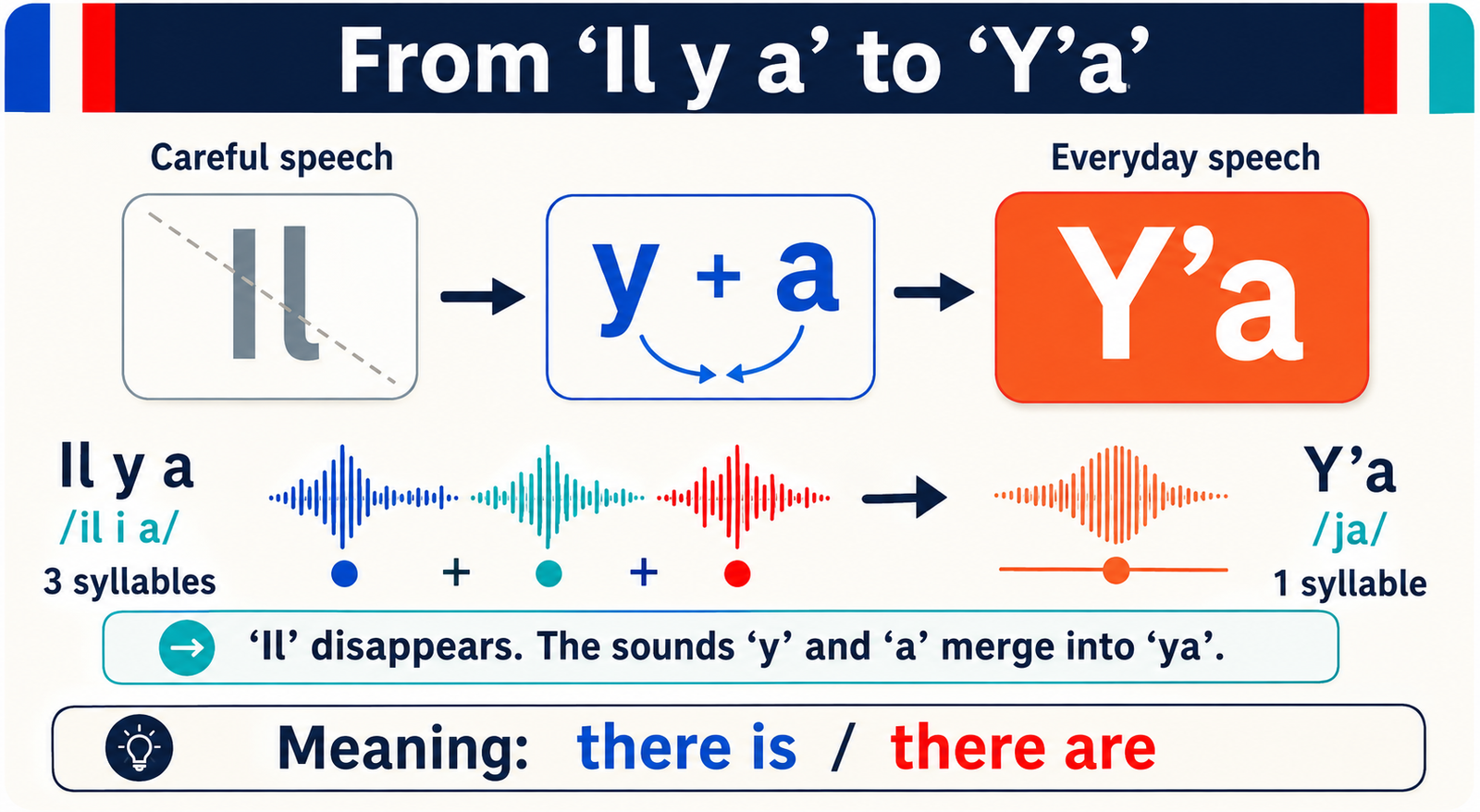
How the common expression “il y a” is reduced to “y’a” in casual spoken French.
1. What Does “Il y a” Mean?
The expression il y a is one of the most common structures in French.
It usually corresponds to English “there is” or “there are.”
There is a problem.
Il y a deux personnes dehors.
There are two people outside.
Il y a du monde.
There are a lot of people / It’s crowded.
The expression can also appear in questions and in other tenses.
2. Why Does “Il y a” Become “Y’a”?
In casual spoken French, il is often omitted from the fixed expression il y a.
This leaves:
il y a → y a → y’a
The remaining sounds combine naturally into one short syllable.
This is best learned as a very common conversational reduction rather than as a general rule saying that French speakers simply delete unstressed pronouns.
French contains many reductions of this kind in spontaneous speech. You can compare this pattern with our lesson on why “je sais pas” often becomes “j’sais pas”.
For a broader look at everyday contractions and reductions, see our guide to real spoken French reductions.
3. How to Pronounce “Y’a”
The reduced form y’a is pronounced approximately:
y’a → /ja/
Think of a short French “ya” sound. The initial sound is similar to the English Y in yes, followed immediately by the French A vowel.
Keep it short. Do not separate the Y and A into two syllables. It should feel like one quick unit: y’a
Do not exaggerate the English word “yeah.” French y’a is shorter and cleaner.
4. Common Everyday “Y’a” Expressions
Once your ears learn to recognize y’a, you will start hearing it in many everyday sentences.
| Casual Spoken French | Full Form | Meaning |
|---|---|---|
| Y’a un problème. | Il y a un problème. | There’s a problem. |
| Y’a du monde. | Il y a du monde. | It’s crowded / There are a lot of people. |
| Y’a quelqu’un. | Il y a quelqu’un. | There’s someone. |
| Y’a quelque chose. | Il y a quelque chose. | There’s something. |
| Y’a beaucoup de monde. | Il y a beaucoup de monde. | There are a lot of people. |
When you hear /ja/ before a noun or noun phrase, ask yourself whether the speaker may be saying il y a in reduced form.
5. The Negative Form: “Y’a pas”
One of the most frequent conversational forms is:
Y’a pas…
It commonly corresponds to:
Il n’y a pas…
In everyday spoken French, the negative particle ne is very often omitted, especially in informal conversation.
There’s no problem.
Y’a pas de place.
There’s no room / There are no seats.
Y’a pas beaucoup de monde.
There aren’t many people.
Y’a personne.
There’s nobody.
In formal or standard written French, prefer: Il n’y a pas de problème. The spelling y’a represents informal spoken language and is mainly used in dialogue, messages, subtitles or deliberately conversational writing.
6. Asking Questions with “Y’a”
The reduced form also appears frequently in conversational questions.
What’s up? / What’s wrong? / What is there?
Y’a quelqu’un ?
Is anybody there?
Y’a un problème ?
Is there a problem?
Y’a encore du café ?
Is there any coffee left?
The exact meaning of Y’a quoi ? depends heavily on context and intonation.
It can literally ask what is present, but it can also mean something closer to “What’s wrong?” or “What’s going on?”
7. “Y’avait” and “Y’aura”
The same conversational reduction is also common with other forms of avoir.
| Full Form | Casual Spoken Form | Meaning |
|---|---|---|
| Il y avait | Y’avait | There was / There were |
| Il y aura | Y’aura | There will be |
There was nobody.
Y’avait beaucoup de monde.
There were a lot of people.
Y’aura du monde demain.
There will be a lot of people tomorrow.
Y’aura un problème.
There will be a problem.
These are common informal spoken forms. In careful or formal writing, use the complete forms il y avait and il y aura.
8. When to Use “Y’a” vs “Il y a”
Both forms belong to real French, but they do not have exactly the same register.
| Situation | Recommended Form |
|---|---|
| Casual conversation with friends | Y’a is very natural |
| Relaxed everyday conversation | Y’a is common |
| Careful spoken French | Il y a may be preferable |
| Presentation or formal speech | Il y a |
| Formal writing | Il y a |
| Dialogue, texting or deliberately informal writing | Y’a may appear |
Learn to recognize y’a immediately before worrying about using it yourself. Understanding reduced French is often more important at first than forcing reductions into your own speech.
9. Common Mistakes English Speakers Make
Mistake 1: Waiting to Hear Every Written Word
If you expect to hear a clearly separated il + y + a, fast conversation may be difficult to recognize.
Train your ears to identify the reduced sound /ja/.
Mistake 2: Pronouncing “Y’a” Like English “Yeah”
The French form should be short and direct, not stretched into an English diphthong.
Mistake 3: Using “Y’a” Everywhere
The reduction is natural in casual speech but not appropriate for every formal situation.
Mistake 4: Writing “Y’a” in Formal French
In essays, professional documents and other formal writing, use il y a.
Mistake 5: Thinking All Pronouns Can Simply Be Deleted
The reduction il y a → y’a is a highly frequent conversational pattern. It should not be treated as a universal rule for deleting French subject pronouns.
10. Listening & Shadowing Practice
Read the full version first. Then repeat the casual spoken version.
Il y a un problème.
→ Y’a un problème.
Il y a beaucoup de monde.
→ Y’a beaucoup de monde.
Il n’y a pas de problème.
→ Y’a pas de problème.
Il y avait quelqu’un.
→ Y’avait quelqu’un.
Il y aura du monde.
→ Y’aura du monde.
Do not pause after y’a. Repeat the entire phrase as one smooth rhythmic group. For example:
Y’a-un-problème.
11. Quick “Y’a” Quiz
1. What does “Y’a” usually represent in casual spoken French?
A. Il y a
✓ Correct! “Y’a” is a very common conversational reduction of “il y a.”
B. Il va
✗ No. “Il va” is a different expression.
2. Which sentence sounds natural in casual conversation?
A. Y’a pas de problème.
✓ Correct! This is a very common informal spoken form.
B. Il un problème.
✗ No. You cannot simply remove the verb.
3. Which form is best for formal writing?
A. Y’a beaucoup de monde.
✗ This reflects informal spoken French.
B. Il y a beaucoup de monde.
✓ Correct! Use the full form in formal written French.
4. What does “Y’avait” represent?
A. Il y avait
✓ Correct!
B. Il y aura
✗ No. “Il y aura” may reduce to “y’aura.”
12. Your 5-Minute “Y’a” Practice Routine
Minute 1 — Full vs Reduced
Repeat:
Il y a → Y’a
Il y a → Y’a
Il y a → Y’a
Minute 2 — Present Tense
Y’a un problème.
Y’a quelqu’un.
Y’a du monde.
Minute 3 — Negative Forms
Y’a pas de problème.
Y’a pas de place.
Y’a personne.
Minute 4 — Past and Future
Y’avait du monde.
Y’avait personne.
Y’aura du monde.
Y’aura un problème.
Minute 5 — Shadowing
Play the audio lesson again and repeat immediately after the speaker.
Focus on copying the rhythm and reduction rather than pronouncing each written word separately.
13. Download the Free “Y’a” Cheat Sheet
Keep the most useful forms from this lesson nearby while practicing. The cheat sheet summarizes il y a, y’a, y’a pas, y’avait and y’aura.
📄 “Il y a” → “Y’a” Cheat Sheet
Use this quick reference to recognize common spoken forms faster.
Download the Free “Y’a” Cheat SheetFinal Takeaway
Spoken French does not always sound exactly like written French.
The expression il y a is a perfect example.
il y a → y’a
Your first goal should be to recognize this reduction immediately when you hear it.
Then practice common forms such as y’a pas, y’avait and y’aura.
You do not need to force every reduction into your own speech. Understanding them first will already make real French conversations much easier to follow.