
If practicing the French R makes your throat feel tense or sore, you are probably using too much force. The French R is produced toward the back of the mouth, but it should not feel like aggressive throat scraping.
For many speakers, the most common modern French R is an uvular sound, produced with the back of the tongue near the uvula. The exact sound can vary slightly depending on the word, the speaker and the surrounding sounds.
To pronounce the French R more comfortably:
1. Keep your throat relaxed.
2. Use gentle airflow rather than force.
3. Bring the back of the tongue toward the uvular area.
4. Do not roll the R with the tip of the tongue.
5. Practice short, easy words before difficult consonant clusters.
The goal is controlled friction, not throat pressure.
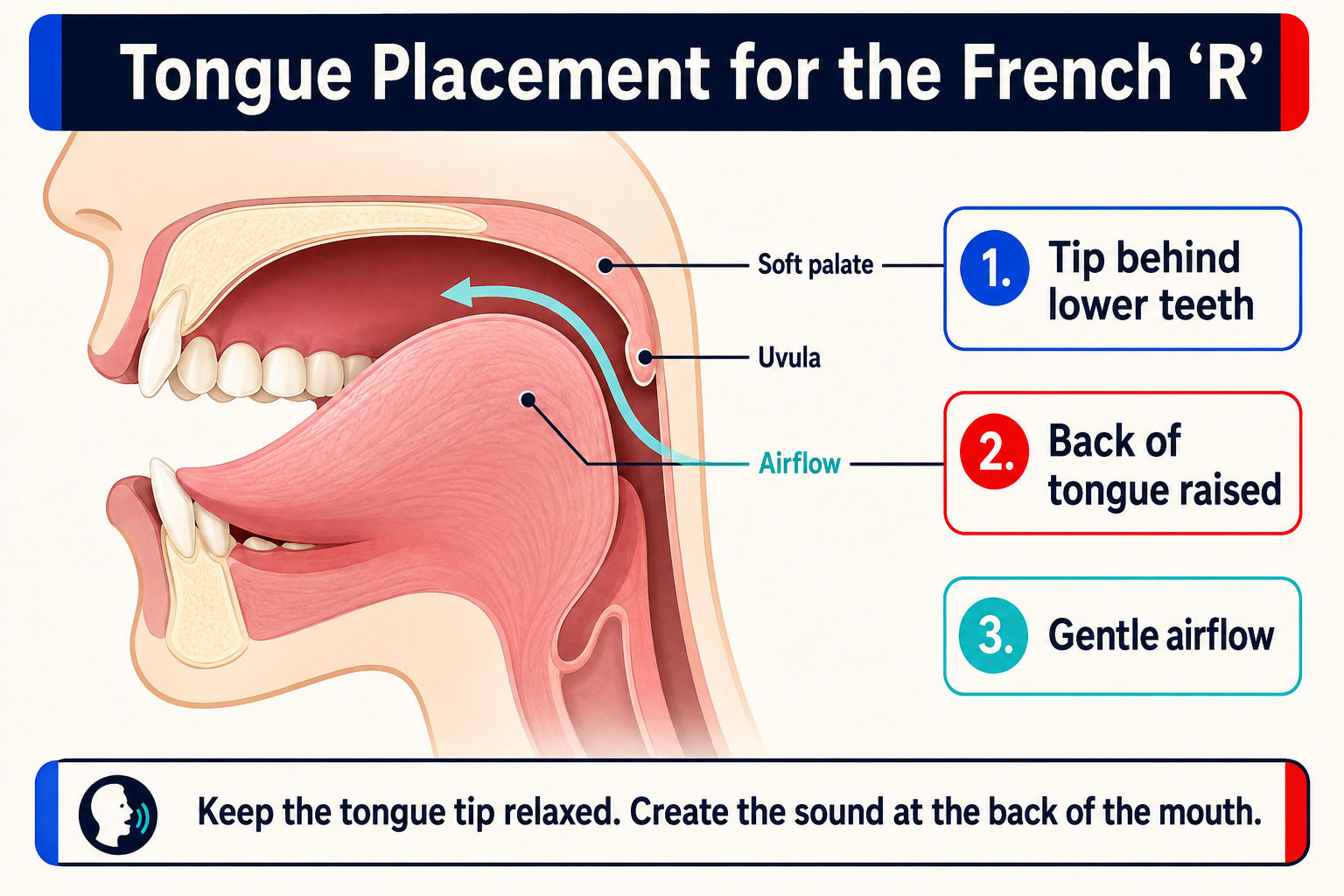
A simplified view of tongue placement and airflow for the French R.
1. What Is the French R?
The French R is very different from the English R and from the rolled R used in languages such as Spanish or Italian.
In much of contemporary French, the sound is produced near the uvula, at the back of the mouth.
R → often /ʁ/
This is commonly described as a voiced uvular fricative or a closely related uvular sound.
You do not need to produce one perfectly identical R in every word. Natural French pronunciation varies slightly with position, speed and surrounding consonants.
For a broader overview of difficult French sounds, see our French Pronunciation Guide.
2. Where Is the Sound Made?
The main action happens at the back of the tongue, not at the tongue tip.
The back of the tongue rises toward the uvular area, leaving a narrow space for air to pass through.
| Part of the Mouth | What to Do |
|---|---|
| Tongue tip | Keep it relaxed. It does not need to roll or tap. |
| Back of tongue | Raise it gently toward the uvular area. |
| Throat | Keep it relaxed. |
| Airflow | Use a small, steady stream of air. |
Think “back of the tongue” rather than “deep in the throat.” That mental image usually helps reduce unnecessary tension.
3. Gentle Airflow, Not Throat Pressure
One of the most common beginner mistakes is trying to force the sound.
The French R should not require a violent burst of air or aggressive throat friction.
Stop and reduce the effort. Pain or irritation usually means you are using too much pressure or tension.
A successful French R often feels smaller and softer than learners expect.
Instead of trying to make a dramatic sound, aim for light friction at the back of the mouth.
4. A Gentle Way to Find the Sound
Some learners find a very gentle gargling motion useful for identifying the general area where the French R is produced.
However, the goal is not to reproduce a strong gargling sound in normal speech.
Step 1 — Relax
Relax your jaw and throat.
Step 2 — Find the Back of the Mouth
Produce a very soft friction sound at the back of the mouth.
Step 3 — Control the Airflow
Keep the airflow light and steady.
Step 4 — Add a Vowel
ra — re — ri — ro — ru
A very gentle gargle can help you notice the uvular area. Use it only as a short awareness exercise, then practice the R with normal airflow and no water.
5. Practice the R in Different Positions
The French R can feel easier or harder depending on its position in the word.
Start with comfortable words before practicing difficult consonant clusters.
| Position | Examples |
|---|---|
| Between or near vowels | Paris, mari, carré |
| At the beginning | rue, rouge, rien |
| At the end | pour, jour, soir |
| After a consonant | très, grand, France |
| In consonant clusters | prendre, croire, propre |
Start with:
Paris → rue → rouge → très → prendre
Move to the next level only when the sound remains relaxed.
6. Why the French R Can Sound Different
You may notice that the French R does not always sound exactly the same.
Depending on its position and neighboring sounds, it can sound more strongly voiced in some words and lighter or partly devoiced in others.
You do not need to consciously control every small variation. Focus first on producing a relaxed uvular R and let natural variation develop through listening and repetition.
Your goal is not to create one exaggerated “perfect R,” but to produce a comfortable sound that fits naturally into French speech.
7. Common French R Mistakes
Mistake 1: Scraping the Throat
A French R does not require aggressive throat clearing.
Reduce the air pressure and relax.
Mistake 2: Using an English R
The English R generally involves a very different tongue shape.
For French, move your attention toward the back of the tongue instead.
Mistake 3: Rolling the Tongue Tip
A rolled or tapped R may occur in some regional or historical varieties of French, but it is not the standard target most learners are aiming for today.
Mistake 4: Practicing Only Isolated R Sounds
You need to practice the R inside syllables and complete words.
A sound that works alone may become difficult when combined with vowels or consonants.
Mistake 5: Using Too Much Air
More air does not automatically create a better R.
Small, controlled airflow is usually more effective.
8. Listen & Repeat
The best way to improve the French R is to combine physical awareness with repeated listening.
🎧 French R Listening & Repetition Practice
Listen to each word and repeat it without forcing the back of your throat. Focus on gentle airflow and a relaxed sound.
How to Practice
- Listen once without repeating.
- Repeat slowly.
- Focus on relaxation rather than volume.
- Repeat the full word, not only the R.
- Increase speed only when the sound remains comfortable.
Paris — mari — carré
Beginning R:
rue — rouge — rien
Consonant + R:
très — France — grand
More advanced:
prendre — croire — propre
9. Quick French R Quiz
1. Where is the most common modern French R produced?
A. With the tip of the tongue against the front teeth
✗ Not usually. The main articulation is farther back in the mouth.
B. Near the uvular area at the back of the mouth
✓ Correct!
2. What should you do if your throat starts hurting?
A. Push more air
✗ No. More pressure usually creates more tension.
B. Reduce the pressure and relax
✓ Correct! The sound should not be painful.
3. Should you roll the French R with the tongue tip?
A. Yes, always
✗ No. That is not the standard pronunciation most learners are targeting.
B. No, focus on the back of the tongue
✓ Correct!
4. What matters most when first practicing the French R?
A. Producing the loudest possible friction
✗ No. Loudness is not the goal.
B. Producing a relaxed and controlled sound
✓ Correct!
10. Your 5-Minute French R Practice Routine
Minute 1 — Relax
Relax the jaw, tongue and throat.
Produce a few gentle R sounds without forcing them.
Minute 2 — R + Vowel
Practice:
ra — re — ri — ro — ru
Minute 3 — Easy Words
Paris
mari
carré
rue
Minute 4 — Consonant Clusters
très
France
prendre
croire
Minute 5 — Shadowing
Play the audio again and repeat immediately after the speaker.
Focus on the complete word and keep the R relaxed.
11. Download the French R Cheat Sheet
Use the French Parrot pronunciation cheat sheet as a quick reference while practicing difficult French sounds, including the French R.
📄 French Pronunciation Cheat Sheet
Review tongue placement, pronunciation reminders and practice strategies in one printable guide.
Download the Free Pronunciation Cheat SheetFinal Takeaway
The French R should not feel painful.
Think of it as a small, controlled friction sound at the back of the mouth, not an aggressive throat-clearing exercise.
relax → gentle airflow → back of tongue → repeat in words
Start slowly, practice easy positions first, and let the sound become more natural through listening and repetition.
A comfortable French R is much more useful than a dramatic one.