
When learning French in a classroom, one of the first full sentences you memorize is “Je ne sais pas” (I don’t know). Yet, if you walk through Paris or listen to a French movie, you will almost never hear anyone say those four distinct words.
Instead, you will hear a rapid “J’sais pas” or even a compressed “Chais pas”. Understanding why and how this happens is a key step toward bridging the gap between textbook grammar and real-world French speech.
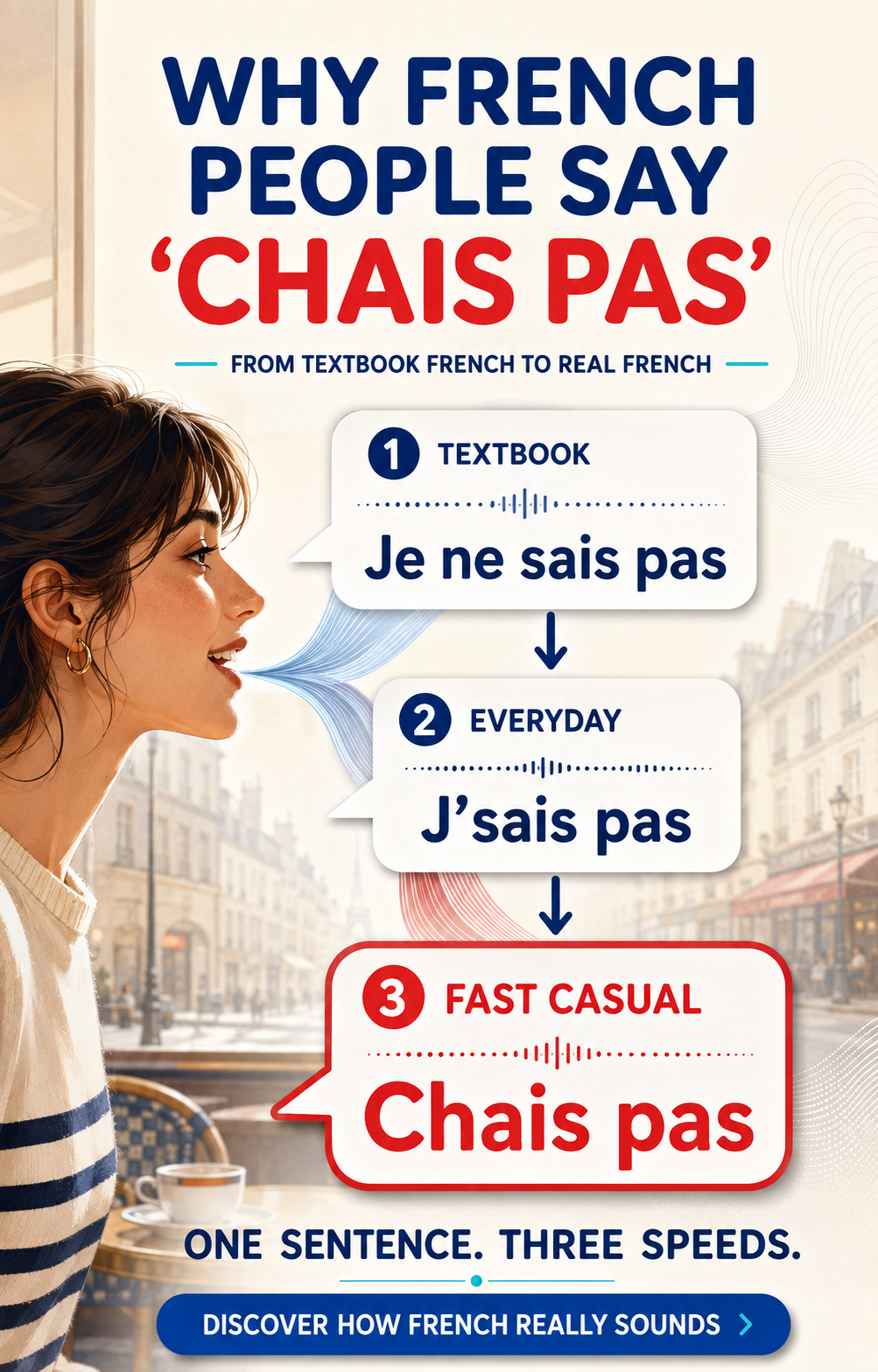
The Four Forms at a Glance
The expression changes according to speaking speed and context. All four forms communicate the same basic meaning, but they do not belong to exactly the same register. Begin by learning to recognize each version before trying to reproduce the most reduced forms.
| Form | Pronunciation | Register | Typical context |
|---|---|---|---|
| Je ne sais pas | /ʒə nə sɛ pa/ | Careful or formal | Exams, presentations and emphasis |
| Je sais pas | /ʒə sɛ pa/ | Everyday spoken French | Ordinary informal conversation |
| J’sais pas | /ʒsɛ pa/ | Casual | Friends, family and relaxed speech |
| Chais pas | /ʃɛ pa/ | Very casual | Fast, spontaneous conversation |
1. Stage 1: Dropping the “NE”
In formal written French, negative sentences require ne before the verb and pas after it. However, in casual oral communication, native speakers drop ne entirely.
Removing ne leaves you with “Je sais pas”. This rule applies across virtually all negative structures in informal speech, keeping with the natural syllable cadence detailed in our lesson on mastering French speech rhythm and liaisons.
2. Stage 2: The Soft “E” Drop
Once ne is removed, the unaccented ‘E’ in je is left exposed between consonants. Native speakers drop this vowel to save effort and increase speech speed.
When the ‘E’ vanishes, the ‘J’ attaches directly to the ‘S’ sound of sais, producing “J’sais pas” (pronounced Zh-say-pah).
3. Stage 3: The “CH” Assimilation
In very fast conversational French, an acoustic process called assimilation takes place. The voiced ‘J’ sound (like the ‘s’ in measure) meets the unvoiced ‘S’ sound in sais. The unvoiced sound wins, transforming J’sais into a clean “SH” or “CH” sound.
This turns the phrase into “Chais pas” (pronounced Shay-pah). You can check audio samples on the Collins French Audio Dictionary to hear how native speakers pronounce fast informal contractions.
Reduction Check
Why does “J’sais pas” often sound like “Chais pas” in fast speech?
Three Real-Life Examples
The reduction becomes easier to understand when you hear it inside a complete exchange. Notice that the meaning remains the same while the pronunciation changes with the level of formality.
— Tu sais où est Paul ?
— Je sais pas. Il est peut-être au café.
“Do you know where Paul is?” — “I don’t know. He may be at the café.”
— Tu viens ce soir ?
— J’sais pas encore. Je te confirme plus tard.
“Are you coming tonight?” — “I don’t know yet. I’ll let you know later.”
— Pourquoi il est parti ?
— Chais pas, moi !
“Why did he leave?” — “I don’t know!”
How to Use This in Conversation
You do not need to force the most compressed pronunciation immediately. For most learners, the first goal should be recognition: when a native speaker says “J’sais pas” or “Chais pas”, your brain should connect it automatically to “Je ne sais pas”.
In ordinary conversation, “Je sais pas” is a natural and widely understood choice. “J’sais pas” sounds more relaxed, while “Chais pas” belongs to very casual and rapid speech. The complete form remains appropriate in formal situations, careful speech, presentations and written French.
Common Mistakes to Avoid
- Using an English “say” vowel: French sais contains /ɛ/, not the English diphthong /eɪ/.
- Pronouncing every word separately: natural speech connects the sounds into one rhythmic group.
- Dropping sounds in formal writing: write Je ne sais pas unless you are deliberately representing informal dialogue.
- Forcing “Chais pas” too early: clear pronunciation is more important than sounding extremely casual.
30-Second Shadowing Practice
Repeat each form three times. Keep the meaning identical while gradually increasing your speed:
- Je ne sais pas.
- Je sais pas.
- J’sais pas.
- Chais pas.
Training tip: record yourself, then compare your rhythm with the audio guide above. Focus on smooth sound connections rather than speed alone.
Download the summary PDF guide for this lesson to practice offline.
Frequently Asked Questions
Is “Chais pas” grammatically correct?
“Chais pas” is not the standard written form. It represents the way Je ne sais pas may sound in very rapid, informal speech. Use it mainly to understand casual conversations or to reproduce spoken dialogue.
Can French learners say “J’sais pas”?
Yes. “J’sais pas” is common in relaxed conversation. However, learners should first pronounce Je sais pas clearly and become comfortable with its rhythm before attempting a stronger reduction.
Why do French speakers omit “ne”?
In everyday spoken French, speakers frequently omit ne because pas already communicates the negative meaning. The complete construction remains standard in formal writing and careful speech.
Should I write “Je sais pas” or “Chais pas”?
In standard writing, use Je ne sais pas. The reduced forms are suitable for informal messages, quotations and dialogue when you deliberately want to represent natural speech.