
French Parrot · Pronunciation Lab · A2–B1
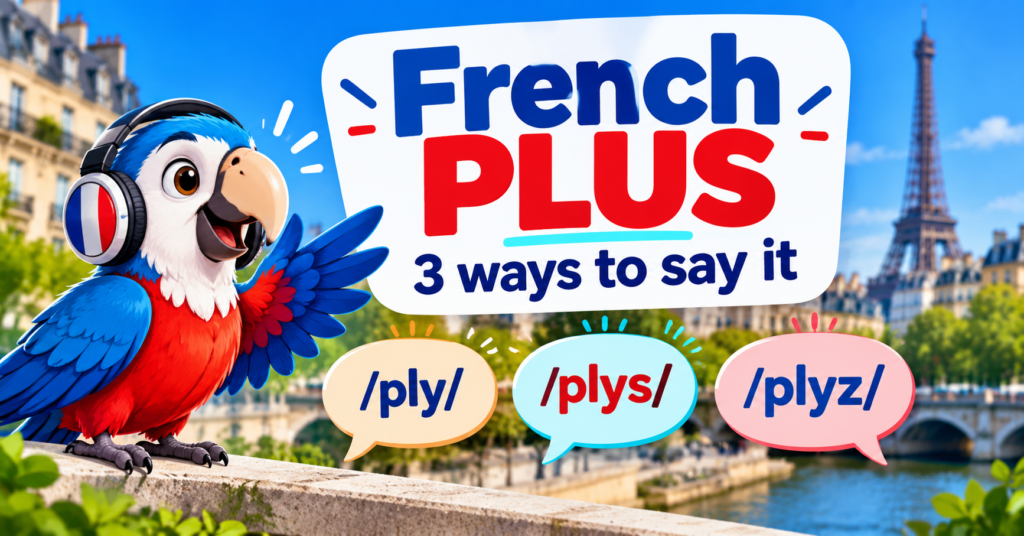
One tiny letter can change what you mean. In French, plus may sound like /ply/, /plys/, or /plyz/. And the difference is not just cosmetic: it can turn “I want more” into “I don’t want any more.”
French PLUS pronunciation depends on meaning, grammar, and the next sound. The s is usually silent in ne…plus before a consonant or a pause; it is often pronounced /s/ when plus means “more” at the end of a phrase; and it may become /z/ in liaison before a vowel.
The French vowel /y/ is the sound of tu, not the English “oo.” Some liaison patterns and registers vary.
1. Why does “plus” have three pronunciations?
The written word plus does several jobs in French. It can express more, no longer, a comparison, or even mathematical addition. The final s responds to those grammatical jobs and to the sounds around the word.
That is why memorizing “the S in plus is always silent” or “plus always sounds like ploos” will lead you astray. Learn a small set of situations instead.
2. /ply/: when the final S is silent
A. “Ne…plus” means “no longer / not anymore”
In everyday conversation, French speakers often drop ne: J’en veux plus can mean “I don’t want any more” when plus is pronounced /ply/. That is one reason pronunciation matters so much.
B. Comparisons before a consonant
Even though plus means “more” here, the S is normally silent before the following consonant. Meaning alone is not enough to predict the sound.
3. /plys/: when you pronounce the S
When plus means more and stands in a strong or final position, the /s/ is commonly audible.
You also hear /plys/ when plus is a mathematical sign or a noun meaning an advantage:
4. /plyz/: when PLUS links to a vowel
Before a word beginning with a vowel sound or h muet, a liaison may turn the written S into a /z/ sound. It connects to the next syllable: plus intéressant sounds approximately like plu-zin-té-res-sant, not “pluss… intéressant.”
Important nuance: /z/ is not limited to positive sentences. A negative phrase such as Elle n’est plus à la maison can also have /z/ liaison in connected, careful speech. The presence of a vowel and the speaker’s register matter.
Want a deeper explanation of this connection? Read our French liaisons guide.
5. French PLUS pronunciation: a practical comparison chart
| Context | Example | Meaning | Sound |
|---|---|---|---|
| Negative | Je n’en veux plus. | I don’t want any more. | /ply/ |
| Positive quantity | J’en veux plus. | I want more. | /plys/ |
| Comparative + consonant | Il est plus rapide. | He is faster. | /ply/ |
| Comparative + vowel | Il est plus agile. | He is more agile. | /plyz/ |
| Addition | Deux plus deux font quatre. | Two plus two equals four. | /plys/ |
6. Five mistakes to avoid
- Pronouncing PLUS like English “ploos.” French uses /y/, the vowel in tu. If this sound is new, revisit our U vs OU lesson.
- Saying /plys/ in every positive sentence. Before a consonant in comparisons, plus grand is normally /ply/.
- Forgetting that /ply/ can mean “no more.” Compare two versions of J’en veux plus.
- Pronouncing /s/ instead of /z/ in liaison. Compare plus intéressant with plus rapide.
- Assuming every negative PLUS blocks liaison. Before a vowel, /z/ may occur in careful speech.
7. Read aloud and shadow
Start slowly. Read the French sentences below, pause, and compare the final sound of plus. Record yourself, then repeat the same sequence more smoothly.
- Je ne veux plus de thé. /ply/
- Il est plus grand. /ply/
- J’en veux plus. /plys/
- Un plus deux font trois. /plys/
- C’est plus intéressant. /plyz/
🎧 Listen & Repeat — French PLUS Pronunciation Practice
Listen to the three pronunciations of PLUS. Repeat each French sentence during the pauses.
Practice tip: Listen once, repeat aloud, then play the recording again to improve your pronunciation.
8. Test yourself: five-question quiz
Choose the pronunciation you expect in each sentence. You will receive a score and explanations.
Show the quiz answer key (works without JavaScript)
1. /ply/ — negative. 2. /plys/ — “more.” 3. /ply/ — comparison before a consonant. 4. /plyz/ — liaison. 5. /plys/ — addition.
9. Five-minute practice routine
- Minute 1: Say Je ne veux plus de thé three times, keeping S silent.
- Minute 2: Say J’en veux plus with a clear final /s/.
- Minute 3: Say C’est plus intéressant with a linked /z/.
- Minute 4: Contrast J’en veux plus (/ply/) and J’en veux plus (/plys/), changing the meaning.
- Minute 5: Record three original sentences and listen for the final sound.
10. Printable practice worksheet
Keep this lesson handy. The two-page printable worksheet includes a pronunciation chart, six recognition questions, translation practice, sentence writing, and a complete answer key.
11. Frequently asked questions
Is the S in French “plus” always silent?
No. Depending on the context, the word may be pronounced /ply/, /plys/, or /plyz/. The written form alone is not enough.
Why is the S silent in “plus grand”?
In a comparative before a consonant, plus is normally /ply/, even though it means “more.”
What is the difference between “J’en veux plus” and “J’en veux plus”?
In informal French, /ply/ can mean “I don’t want any more,” whereas /plys/ can mean “I want more.” In careful writing, Je n’en veux plus makes the negative meaning explicit.
Can negative “plus” ever have a /z/ sound?
Yes. Before a vowel, liaison may be heard in careful or connected speech, as in Elle n’est plus ici. Patterns vary by speaker and register.
How do you pronounce “plus” in maths?
As an addition sign, it is pronounced /plys/: Deux plus trois font cinq.
12. Keep learning with French Parrot
To understand why the /z/ links words together, explore our liaison lesson. For a clearer French /y/ vowel, revisit French U vs OU pronunciation. And to understand why ne may disappear in everyday speech, see spoken French reductions.
Final takeaway: French PLUS pronunciation is a small but powerful listening skill. Hear the meaning, check the next sound, and practise the complete phrase—not just the word on its own.